In building and plant projects, the number of flow analysis cases grows quickly. Combine 5 building layout alternatives, 4 opening conditions and 16 wind directions, and you have 320 cases. At 4 hours per case, that is 53 days by simple arithmetic. Design schedules won’t wait for that, so in practice most teams compute a few selected cases and estimate the rest.
The question is “which cases to pick”
Experienced engineers usually pick well. But the basis for those choices is hard to explain to a third party, and when a review board asks “why did you review only these conditions?”, the answer falls flat. The bigger problem is that there are combinations intuition misses. Zones where each variable alone is fine but performance deteriorates sharply under one specific combination are, in practice, found often.
The Role of the Surrogate Model
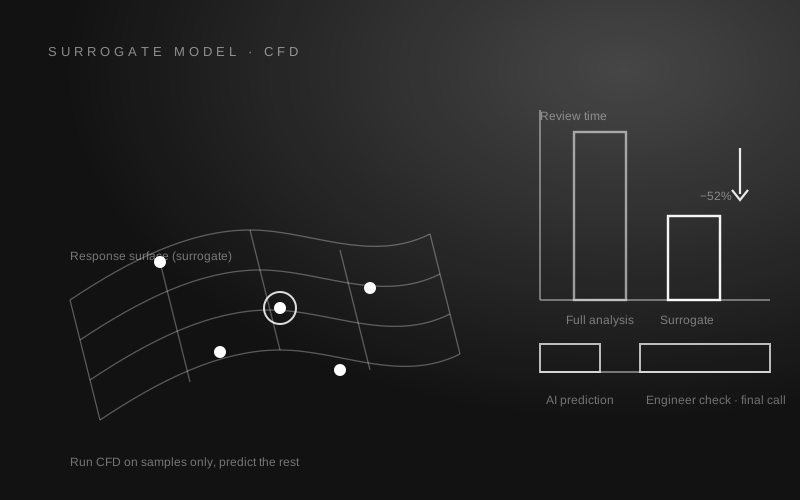
A surrogate model learns from a small number of detailed analysis results to approximate the results for all remaining conditions. The key point is that surrogate predictions are not used as conclusions. A surrogate model is strictly a map showing where to look closely.
Practical Workflow
- Step 1 — Initial sampling · Select 20–40 cases that evenly cover the design variable space and run detailed CFD on them. Use space-filling methods such as Latin hypercube sampling, not random selection.
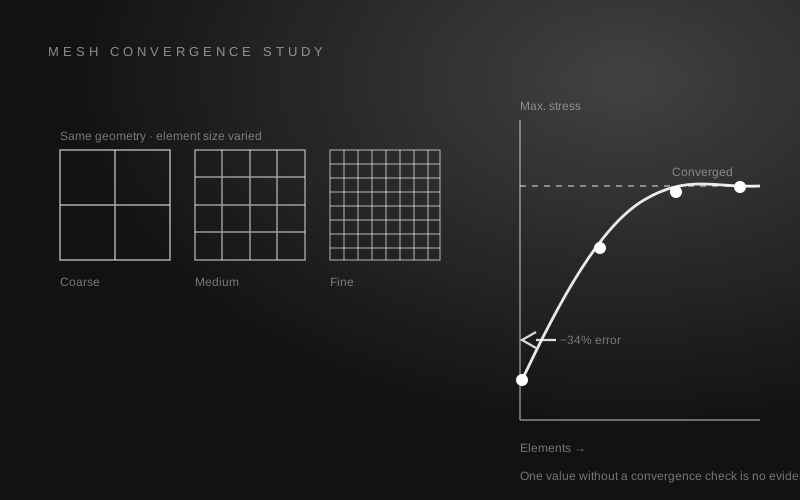
- Step 2 — Surrogate training · Build a response surface from the initial results and quantify prediction error by cross-validation. If the error exceeds the tolerance, add samples.
- Step 3 — Full-domain scan · Use the surrogate to sweep all combinations in seconds and identify risk zones and candidate optimum zones.
- Step 4 — Targeted detailed analysis · Recompute only the risk-zone boundaries and 10–20 optimum candidates with detailed CFD to confirm them.
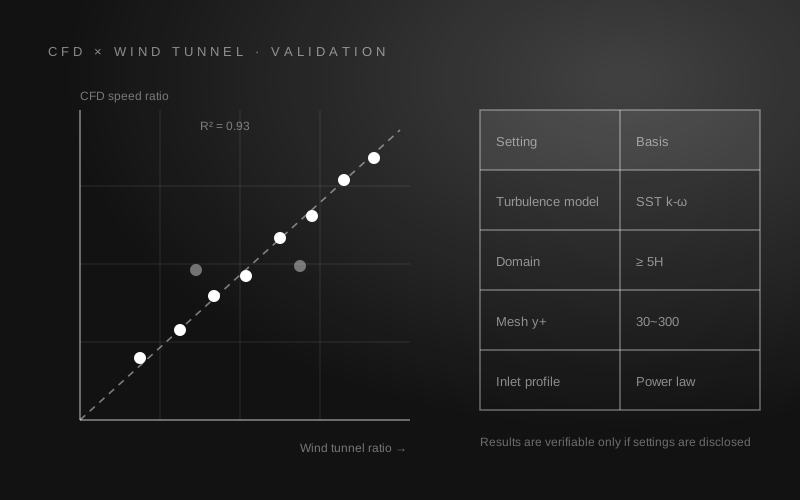
- Step 5 — Verification and reporting · Compare detailed analysis results with surrogate predictions and state the model’s confidence interval in the report.
Real Benefits and Limits
In a site layout review by DINETT, detailed analyses were cut to 54 cases versus 320 for full computation. The review period was roughly halved, and the number of conditions reviewed actually increased. Two risk combinations that intuition would not have selected were discovered along the way.
The limits are clear, however. Where physical behavior changes discontinuously — for example, conditions in which flow separation suddenly occurs — surrogate predictions can be far off. That is why areas of low surrogate reliability must always be checked with detailed analysis, and why this judgment must not be left to automation.
AI is used to widen the scope of review, not to reach conclusions. Final determinations must rest on detailed analysis results and engineering judgment, and reports must clearly indicate which cases are detailed analyses and which are predictions.
Where to Start
Not every project needs this approach. With fewer than 50 cases, full computation is simpler and safer. The approach pays off when there are three or more variables, more than 100 combinations, and a tight design schedule.
Embedding this workflow in an organization also requires analysis automation scripts and a results management system. DINETT supports clients all the way through the transfer of procedures and templates, so they can run it with their own in-house capabilities.
This article is based on the hands-on experience of DINETT’s Engineering Simulation division. For specific applications or project consultations, please contact us through Service Inquiry.