Discipline 04 — Testing & Measurement

Testing · Inspection · Measurement

Analysis starts from assumptions; measurement turns them into facts. DINETT performs wind tunnel testing, non-destructive testing, and noise, vibration, air quality and asbestos surveys in-house to calibrate analysis models and capture, as data, the actual site conditions that drawings don’t show.

  • Wind Tunnel Testing · Wind Environment Design
  • Non-Destructive Testing (UT · MT · PT)
  • Noise · Vibration · Air Quality Measurement
  • Asbestos Survey · Abatement · Supervision
Overview

What isn’t measured
can’t be managed

DINETT keeps its measurement team in-house for a clear reason. When analysis and measurement are done by different companies, conditions diverge, and when results disagree the cause cannot be traced. Only when the same team builds the model and attaches the sensors do the two sets of results truly speak to each other.

Measurement results are never delivered as a mere list of numbers. Comparison with statutory standards, trends over time, even the causes of outliers are organized in an interpretable form so the client can decide on next steps.

Where a one-off measurement cannot support a judgment, we propose a permanent monitoring system. For structural behavior and indoor environments, the trend of change tells more than the value at any single moment.

In-HouseMeasurement within the same organization as the analysis team, so conditions match
LegalCompliance assessment against statutory standards and accredited test reports
24/7Continuous monitoring system setup and data analysis support
CLUSTER A

Wind Tunnel Testing · Wind Environment Design

01 — 03

We apply real wind to scale models to verify performance. Where facades are irregular or surrounding buildings have complex effects, testing confirms results that numerical analysis alone cannot establish with confidence.

01

Wind Tunnel Testing · Wind Environment DesignWind Tunnel Test & Design

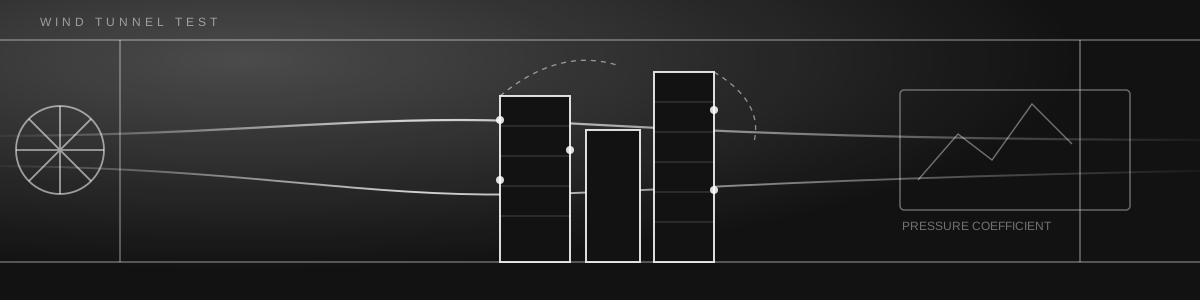
We design the test objectives, model scale and measurement points, and manage the entire process of incorporating test results into the design — including assessment against pedestrian wind comfort criteria and validation of mitigation options such as windbreak walls and canopies.

Test planning · Wind comfort · Mitigation validation
02

Building Wind Tunnel TestingBuilding Wind Tunnel Test

We determine cladding design pressure coefficients and overall structural wind loads for high-rise buildings by testing. This often yields more rational values than uniformly applying code wind pressures, reducing cladding costs.

Cladding pressure coefficients · Structural wind loads · Review response

03

Structure Wind Tunnel TestingStructure Wind Tunnel Test

We verify aerodynamic instability (galloping, flutter, vortex-induced vibration) in special structures such as bridges, towers and roof trusses, and review vibration control measures.

Bridges · Towers · Aerodynamic instability · Vortex-induced vibration

Wind tunnel testing image showing a scale model, airflow and wind pressure measurement points inside the tunnel
CLUSTER B

Inspection · Measurement · Analysis

04 — 07

We check the internal condition of structures without damaging them and compare the environment of occupied spaces against statutory standards. This is the primary data underpinning safety diagnosis, permitting and complaint response.

04

Non-Destructive TestingNon-Destructive Testing

We verify internal defects and actual strength without damaging the structure. NDT is a key tool when as-built drawings are missing and member data must be reconstructed, or when weld quality needs objective verification. The method is chosen to suit the material and the nature of the defect.

3 test methods
  • Ultrasonic Testing (UT) — internal defects in welds and members
  • Magnetic Particle Testing (MT) — surface and near-surface cracks in steel
  • Liquid Penetrant Testing (PT) — surface-breaking defects in non-magnetic materials

UT · MT · PT · Rebound hardness · Rebar scanning

05

Noise · Vibration MeasurementNoise & Vibration Measurement

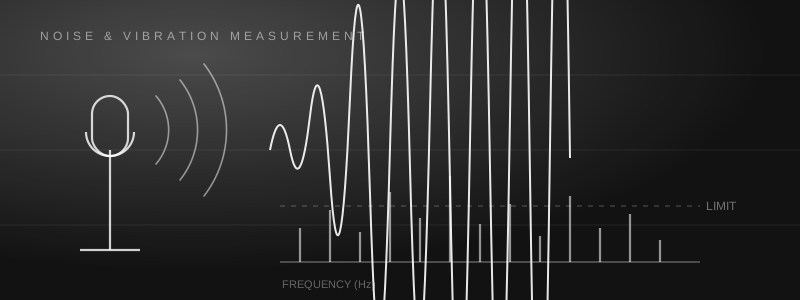
We measure compliance with community noise and vibration regulatory standards, and separate sources and their contributions through frequency and time-series analysis. The goal is not a list of numbers but an answer to “What is the cause, and what needs fixing?”

3 sub-services
  • Noise · Vibration regulatory standards review
  • Noise analysis · Assessment · Prediction
  • Vibration analysis · Assessment · Prediction

Regulatory standards · Frequency analysis · Source diagnosis

06

Air Quality MeasurementAir Quality Measurement

We measure indoor air quality (fine dust, VOCs, formaldehyde, etc.) and diagnose the data. A continuous measurement system can be installed to verify improvements over time.

2 sub-services
  • Air quality measurement system setup
  • Air quality data analysis · Diagnosis

Indoor air quality · Continuous monitoring · Improvement verification

07

Asbestos Survey · Abatement · SupervisionAsbestos Survey & Abatement Supervision

We cover the full process — from the asbestos survey legally required before demolishing aging buildings, through sample analysis, risk assessment and supervision of abatement and removal, to post-completion management.

5 sub-services
  • Asbestos measurement
  • Asbestos risk assessment
  • Asbestos sample analysis
  • Asbestos abatement · Removal · Supervision
  • Asbestos-containing building management

Statutory survey · Sample analysis · Abatement supervision

Noise and vibration measurement image showing a microphone, noise waveform and frequency spectrum
How We Deliver

Our Process

Measurement reliability is decided at the planning stage. Where, when and under what conditions you measure determines what the results mean.

We design measurement points, times and conditions differently depending on whether the purpose is regulatory reporting, root-cause investigation or analysis validation. Applicable standards and the test report format are also fixed at this stage.
  • Checkpoints: submission authority, applicable regulations, measurement time window, background conditions
  • Deliverables: measurement plan, measurement point layout, applicable standards specification
We record factors that affect results — background noise, weather, equipment operating status — and install instruments with verified calibration history.
  • Checkpoints: background levels, weather conditions, equipment operating status
  • Deliverables: site condition records, confirmation of equipment calibration certificates
If anomalies occur during measurement, we immediately identify the cause and re-measure if needed. Data is preserved in its original form, with a record of all processing.
  • Checkpoints: timing of anomalies, external interference factors
  • Deliverables: raw data, field logbook, anomaly handling records
We interpret what the numbers mean through frequency analysis, time-series analysis and more. Where standards are exceeded, we present the causes and their contributions separately.
  • Checkpoints: exceedances, contribution by source, variation by time of day
  • Deliverables: analysis report, compliance assessment against standards, root-cause diagnosis
We issue accredited test reports and, where needed, continue through mitigation design and post-construction verification measurements.
  • Checkpoints: expected reduction per measure, budget range
  • Deliverables: test report, improvement proposals, post-verification measurement results
Deliverables

What You Receive

  • Test report — accredited document suitable for statutory submission
  • Wind tunnel test report — pressure coefficients, wind loads, pedestrian wind speed distribution
  • NDT results — defect location and size assessment, with interpretation records
  • Measurement data set — raw data with processing history
  • Analysis report — frequency and time-series analysis with compliance assessment
  • Root-cause diagnosis — sources and contributions separated where standards are exceeded
  • Asbestos survey report — sample analysis results, risk rating, abatement plan
  • Monitoring dashboard — real-time access when continuous monitoring is installed
Sectors We Serve

Applications

Facility typeTypical work
Supertall · Large BuildingsWind tunnel testing, cladding wind pressure, post-completion behavior monitoring
Bridges · Special StructuresStructure wind tunnel testing, aerodynamic instability verification, vibration control
Construction sitesAdjacent building monitoring, blasting and pile-driving vibration, temporary works inspection
Factories · PlantsWeld UT/MT/PT, equipment vibration diagnosis, workplace noise
ApartmentsFloor impact and equipment noise, indoor air quality, crack progression monitoring
Aging buildingsAsbestos survey and abatement supervision, concrete strength, rebar scanning
Precision Industrial FacilitiesMicro-vibration in semiconductor and research facilities, cleanroom environment monitoring

When measured results differ from analysis results, we review them jointly with the simulation team until the cause is identified. Our principle is never to report a data discrepancy as is. Where a structural safety judgment is needed, the Structural Engineering team follows up with a Professional Engineer review.

You don’t need to know yet
what needs checking.

Tell us your current situation and concerns, and we’ll start by outlining which measurements are needed and what they can reveal.